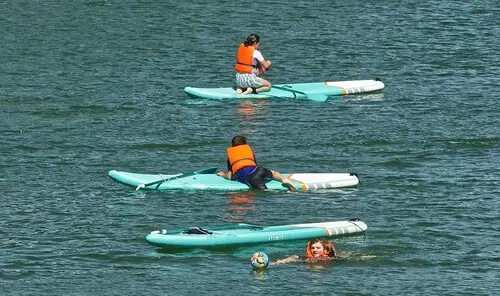
Course Set - Aquatic Safety and Rescue for Education Settings (HLTAID009, SISCAQU020 & SISCAQU029)


This course is designed for individuals such as educators, lifeguards, outdoor recreation leaders, and others who supervise water-based activities and are required to respond to aquatic emergencies. Participants will develop the ability to perform water rescues appropriate to the location and provide cardiopulmonary resuscitation (CPR) to a casualty in a range of community and workplace settings, in line with current Australian Resuscitation Council (ARC) guidelines and workplace procedures.

The course provides the knowledge and practical skills required to manage participant safety in both controlled aquatic facilities and open water environments. Training covers hazard identification, rescue planning, and the use of appropriate rescue techniques and equipment, including rescue tubes, rescue boards, and other non-motorised craft. Participants will learn to manage risks associated with changing environmental conditions such as currents, waves, visibility, weather, and crowded venues, and to communicate effectively with team members, bystanders, and emergency services during an incident.

The program includes a range of rescue scenarios such as multiple people in difficulty, medical emergencies in the water, and suspected spinal injuries, with an emphasis on safe rescue, post-rescue care, incident reporting, and maintaining confidentiality in accordance with organisational and legislative requirements.

Units Delivered

The following units will be included in your certificate:

Course Delivery

This course can be delivered/assessed in the workplace or at facility organised by the training provider.

Course Durations

Course durations can vary for multiple reasons, so the durations below are the minimum possible amount.

Face-to-Face face-to-face contact time of at least 8 Hours
Online with face-to-face assessment face-to-face contact time of at least 4 Hours

An individual undertaking this course with Allens Training Pty Ltd will need to demonstrate the following to be eligible for entry:

  • An official form of photo identification (e.g., driver’s licence, passport, or student ID).
  • Physical capability to be able to meet the demands of the practical demonstration skills including:
    • CPR*
  • The physical fitness and strength to conduct various swim rescue techniques including:
      • Swim 10 metres and perform a 10-metre non-contact tow of a casualty and remove the casualty from the water without assistance
      • Swim 10 metres and perform a 10-metre contact tow of a conscious casualty using a rescue tube, negotiating prevailing conditions and environmental hazards
      • Perform 25-metre open water rescue using non-motorised watercraft (e.g., a rescue board, paddle board, paddle craft), negotiating prevailing conditions and environmental hazards
  • Perform non-swim rescues – reach and throw rescues
  • Visual acuity to see the common visual signs and signals of a person experiencing difficulties in the water
  • Hear the common signals of a person experiencing difficulties in the water which includes “call for help”

As this unit applies particularly to open water lifeguards and individuals such as outdoor recreation leaders, who complete complex water rescues, it is expected that students will have a basic understanding of performing water rescues, prior to undertaking this unit. In addition, it is recommended students can swim 400 metres in less than 12 minutes.

  • To successfully complete this course, students will need to demonstrate the following language, literacy, numeracy and digital (LLND) skills during training and assessment:
    • Learning: Remember and follow steps to help keep myself and others safe in and around water, particularly in a rescue situation
    • Reading: Read and understand detailed signs, safety rules, and instructions in places where water safety is important
    • Writing: Fill out forms, write short notes (such as field notes or incident reports), and clearly record key details from rescue operations
    • Oral communication: Communicate clearly and listen carefully when receiving or giving instructions, especially in team-based, noisy, or time-sensitive situations
    • Numeracy: Use numbers to track time, check water depths, and judge distances to help make safe decisions
    • Digital Literacy: Able to use a mobile phone or basic device to read messages, follow online instructions, complete online forms or access learning resources

Delivery mode: Online with face-to-face The online pre-course learning and theory assessment is expected to take approximately 3-4 hours to complete. These timeframes are estimates. Individuals with prior experience in similar training may complete the online component in less time, while those new to the subject may need more time to complete all the learning content and theory questions.

Students must have basic digital literacy skills to navigate online platforms, complete assessments, and access course materials. Before enrolment, students should assess their ability to engage in online learning. Support is available where required. 

The online learning program can be found in the student portal. Students must have access to a computer, smart phone, tablet or other electronic device with access to the internet to complete the online studies and associated assessment tasks.

Individuals undertaking this course will be expected to complete both written and practical assessment tasks.

The units have the following recommended renewal periods:
Unit Period
HLTAID009 - Provide cardiopulmonary resuscitation 12 months
SISCAQU020 - Perform water rescues Not applicable
SISCAQU029 - Perform open water rescues 0 months

Please note that enrolment to this course is made with Allens Training Pty Ltd RTO 90909. Please refer to the student handbook located on the RTO website allenstraining.com.au (https://allenstraining.com.au/students/student-handbook) for all details relating to rights and responsibilities including complaints and appeals.

Performance Tasks

  • Performance Task – Adult CPR (incl. defibrillation and managing an unconscious breathing casualty)
  • Performance Task – Infant CPR
  • Demonstrate the fitness and strength and effective rescue equipment use to participate in five (5) simulated water rescues:
    • Perform two (2) non-swim rescues:
      • Reach rescue
      • Throw rescue
    • Perform three (3) swim rescues:
      • Swim 10 metres and perform a 10-metre non-contact tow of a casualty and remove the casualty from the water without assistance
      • Perform a 10-metre contact tow of a submerged casualty with rescue tube and remove casualty from water with assistance from one (1) person
      • Perform 25-metre open water rescue using non-motorised watercraft (e.g., a rescue board, paddle board, paddle craft), negotiating prevailing conditions and environmental hazards

Documentation  complete one (1) Incident Report form

Theory assessment  A written exam consisting of multiple-choice and short answer questions must be completed at the end of the training session. Students must answer all questions

Students are required to complete a self evaluation against the following core skills as part of the enrolment process. This will allow your trainer to understand any additional support that may be required during the course delivery and assessment.
Learning I can remember and follow steps to help keep myself and others safe in and around water, particularly in a rescue situation
Reading I can read and understand detailed signs, safety rules, and instructions in places where water safety is important
Writing I can fill out forms, write short notes (such as field notes or incident reports), and clearly record key details from rescue operations
Oral Communication I can communicate clearly and listen carefully when receiving or giving instructions, especially in team-based, noisy, or time-sensitive situations
Numeracy I can use numbers to track time, check water depths, and judge distances to help make safe decisions
This course is delivered and assessed on behalf of Allens Training Pty Ltd RTO 90909